This practical guide explains the key components of IAM and how the core pillars of Identity and Access Management are evolving for AI-driven, identity-first enterprises.
Why the Components of IAM Matter for Modern Cybersecurity
The traditional network perimeter has effectively disappeared. Employees work from anywhere. Applications span multiple clouds and thousands of SaaS platforms. Meanwhile, APIs, bots, and AI agents interact with corporate systems around the clock. In this environment, identity, not the network, has become the true security boundary.
Identity and Access Management (IAM) combines practices and technologies that control access. It gives the right people and machines the right level of access at the right time, and nothing more. Done well, IAM reduces breach risk, satisfies auditors, and removes friction for legitimate users. Done poorly, it becomes the single biggest gap attackers exploit. In fact, most breaches today begin with a compromised or over-privileged identity rather than a broken firewall.
This guide explains the components of IAM that every security and IT leader should understand in 2026. It covers four foundational pillars, the tools that support them, and the trends reshaping identity strategy.
Key Components of IAM: The Four Core Pillars
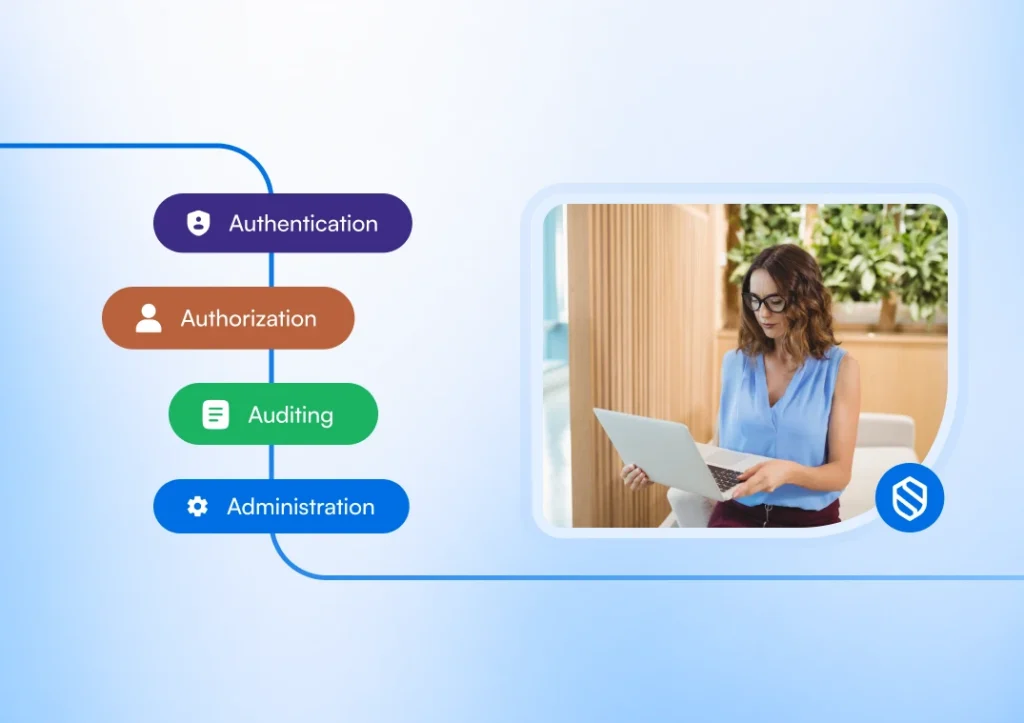
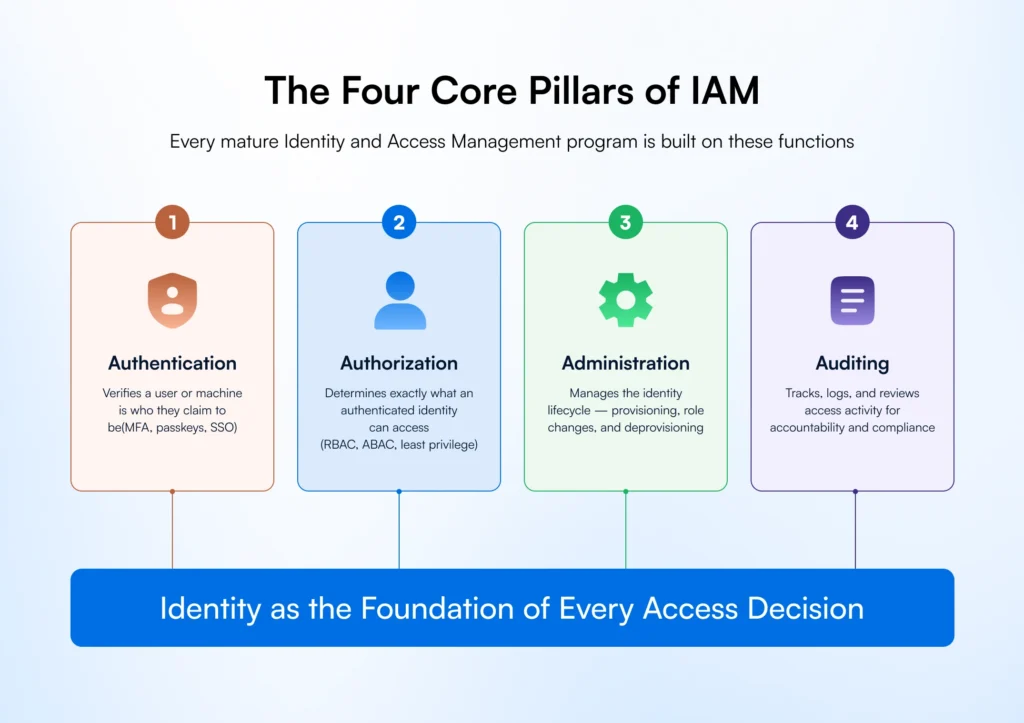
Ask ten security practitioners about the four components of Identity and Access Management. Most will give the same answer, often called the “four A’s.” Together, these four pillars of identity and access management form the operating model that every other IAM capability plugs into.
1. Authentication: Verifying Identity
Authentication answers a single question: are you who you claim to be? For example, it covers passwords, one-time codes, multi-factor authentication (MFA), and biometrics. It also includes passwordless methods such as passkeys that use FIDO2 and WebAuthn standards. In 2026, organizations have moved beyond a single check at login. Instead, continuous, risk-based verification reassesses trust throughout a session.
2. Authorization: Enforcing the Right Access
After authentication, authorization determines exactly what that identity is permitted to do. Organizations typically enforce authorization through role-based access control (RBAC), attribute-based access control (ABAC), or both. In addition, the principle of least privilege guides these controls. Therefore, strong authorization prevents a classic failure mode: a legitimate, authenticated user gaining access to data or systems far beyond what their job requires.
3. Administration: Managing the Identity Lifecycle
Administration is the operational engine of IAM. It governs account creation, also called provisioning, and changes access as roles evolve. Crucially, teams remove access when someone leaves or when they retire a machine account. Delays often create unauthorized access. After all, attackers frequently target stale accounts and orphaned entitlements.
4. Auditing: Proving Accountability
Finally, the fourth pillar closes the loop. Auditing and reporting capture who accessed what, when, and how. As a result, teams can detect anomalies, investigate incidents, and demonstrate compliance with SOX, HIPAA, and GDPR. In 2026, teams increasingly use continuous, automated monitoring instead of periodic manual reviews. They also connect this monitoring directly to SIEM and XDR platforms.
| Pillar | Core Question | What It Covers |
| Authentication | Are you who you say you are? | Passwords, MFA, passkeys, biometrics, and federated sign-in used to verify identity. |
| Authorization | What are you allowed to do? | Role-based (RBAC) and attribute-based (ABAC) policies that enforce least-privilege access. |
| Administration | How is your access managed over time? | Provisioning, role changes, and deprovisioning across the full identity lifecycle. |
| Auditing | Can you prove what happened? | Logging, monitoring, and reporting that support accountability and regulatory compliance. |
Beyond the Four Pillars: The Extended IAM Component Stack
The four A’s describe IAM’s core functions, but modern enterprises implement them through a broader set of identity and access management components working together. Together, these building blocks turn the four pillars into a working, scalable system.

- Directory Services: The central, authoritative repository of identities and their attributes, such as Active Directory, Entra ID, or a cloud-native identity store that every other component reads from.
- Single Sign-On (SSO): Lets a user authenticate once and gain access to multiple applications, reducing password fatigue and shrinking the attack surface created by scattered credentials.
- Multi-Factor Authentication (MFA) and Passwordless Access: Adds additional, independent proof of identity and, increasingly, replaces passwords entirely with device-bound passkeys.
- Privileged Access Management (PAM): Applies stricter controls, session recording, and just-in-time elevation to high-risk administrative and service accounts.
- Identity Governance and Administration (IGA): Automates access certification, entitlement reviews, and policy enforcement so governance scales with the organization instead of relying on spreadsheets.
- Non-Human Identity (NHI) Management: Applies IAM discipline to APIs, service accounts, bots, and AI agents, a category that, by most 2026 estimates, now outnumbers human identities inside the enterprise by a wide margin.
Components of IAM in an Access Management System
In practice, organizations often treat access management as an IAM subset. It focuses on runtime access decisions rather than the broader identity lifecycle. A well-built access management system typically includes:
- A policy engine that evaluates each access request in real time against defined rules and context (device, location, risk score).
- Session management that tracks active sessions and can revoke access instantly when risk indicators change.
- Adaptive, risk-based access controls that step up authentication requirements when behavior looks unusual.
- Federation and SSO protocols such as SAML, OAuth 2.0, and OpenID Connect that allow trust to be extended securely across applications and partner organizations.
- Centralized policy administration so access rules are defined once and applied consistently across cloud, on-premises, and SaaS environments.
Components of IAM: Trends Shaping 2026
Although the components of IAM remain familiar, they are the same building blocks security teams have relied on for years, but how they are implemented is changing quickly. In particular, several trends are defining IAM strategy in 2026:
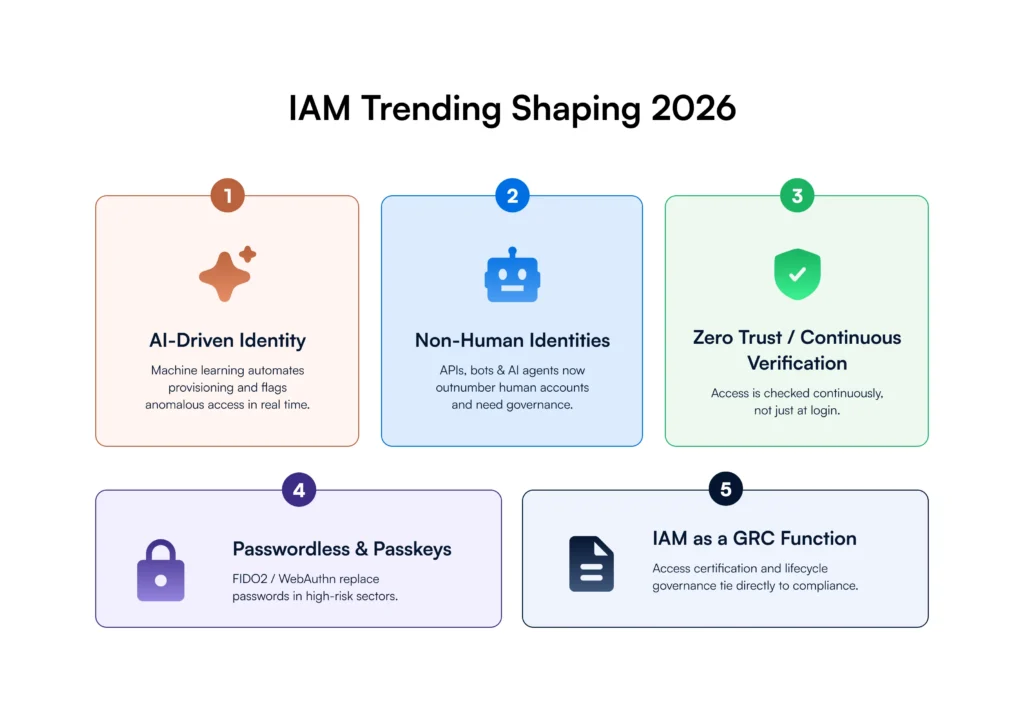
AI-driven identity operations. Machine learning increasingly automates provisioning, deprovisioning, and anomaly detection. For example, it flags sudden privilege escalation much faster than a manual review.
Governance of non-human and AI agent identities. As autonomous AI agents act inside enterprise systems, organizations extend controls to machine identities. These controls include purpose-bound credentials, lifecycle management, and continuous monitoring.
Zero Trust matures into continuous verification. Zero Trust architectures no longer trust an entire session after login. Instead, they re-evaluate identity, device posture, and context throughout the session.
Passwordless goes mainstream. Passkeys and FIDO2/WebAuthn now replace passwords in high-risk sectors such as banking and healthcare. Consequently, they reduce phishing-related account takeovers.
IAM becomes a GRC function. Moreover, regulators are treating identity controls as core to cyber hygiene, pushing access certification, privileged access management, and identity lifecycle governance into the compliance conversation.
Deeper convergence with SIEM and ITDR. As attackers increasingly target credentials and service accounts to move laterally, tighter integration between IAM, SIEM, and Identity Threat Detection and Response (ITDR) platforms has become a security priority.
Best Practices for Implementing the Components of IAM
Ultimately, understanding the components of IAM is the first step; implementing them well is what actually reduces risk. For example, the following practices consistently separate resilient IAM programs from vulnerable ones.
| Practice | Why It Matters in 2026 |
| Adopt least-privilege by default | Limits blast radius when human or machine credentials are compromised. |
| Extend governance to non-human identities | APIs, bots, and AI agents now outnumber human accounts in many enterprises. |
| Move toward passwordless authentication | Passkeys and FIDO2/WebAuthn sharply reduce phishing and credential-stuffing risk. |
| Automate access certification | Manual entitlement reviews cannot keep pace with dynamic, cloud-first environments. |
| Integrate IAM with SIEM/XDR | Closer alignment with Identity Threat Detection and Response speeds up containment. |
Bringing the Components of IAM Together
Identity and Access Management is no longer a background IT function; it is the strategic core of enterprise security. Four foundational pillars support every IAM program: authentication, authorization, administration, and auditing. However, delivering them at enterprise scale in 2026 requires a broader stack: directory services, SSO, MFA and passwordless authentication, PAM, IGA, and increasingly, dedicated governance for non-human and AI identities.
Organizations should treat these components as one integrated system, not as disconnected tools. This approach reduces breach risk, satisfies regulators, and supports secure, frictionless access for people and machines. Whether you are evaluating your current IAM maturity or planning a modernization roadmap, revisiting these core components is the right place to start. Learn how Sennovate supports modern identity security programs.
Related Articles
Just-in-Time Provisioning: How Temporary Access Reduces Identity Risk
An engineer receives administrator access to fix a production issue. The repair takes 30 minutes....