For mid-market IT teams evaluating top MFA solutions, cyber insurers have moved well past the basic checkbox. They’re asking for proof: coverage breadth, method quality, audit logs, and evidence that every privileged account is protected. For organizations running 500 to 2,000 seats, commercial MFA licensing adds up fast. At $6 to $9 per user per month, a range typical of platforms like Microsoft Entra P1/P2, a 1,000-seat organization faces $72,000 to $108,000 annually just for authentication. Open-source MFA can meet enterprise compliance requirements when properly deployed, and it’s the path security teams choose when they want control, flexibility, and cost efficiency without sacrificing their compliance posture.
Vendor marketing rarely covers the three things that actually determine whether a deployment succeeds: how complex integration gets against your existing identity stack, whether the solution satisfies what insurers actually audit, and what “free” truly costs once implementation and support are factored in. Sennovate’s IAM practice works through this evaluation with mid-market IT leaders regularly, deploying MFA on top of existing Okta, Microsoft Entra, and CyberArk environments without the rip-and-replace disruption that large vendors typically push.
What makes an open-source MFA solution enterprise-ready
Deployment model: self-hosted vs. cloud-assisted
Every open-source MFA solution forces a fundamental choice: fully self-hosted or hybrid with cloud-assisted components. Self-hosted means your team owns patching, high-availability architecture, certificate management, and incident response. For mid-market IT teams without a dedicated identity engineer, that operational overhead is real and recurring. Cloud-assisted deployments reduce that burden but introduce dependency on external services, a risk profile that may conflict with data residency requirements in regulated industries, particularly where vendor cloud components store authentication metadata outside customer-controlled regions.
The right model depends on your team’s capacity and your compliance obligations. Some healthcare organizations under HIPAA prefer self-hosted deployments for tighter data control, though the regulation itself doesn’t mandate it. A SaaS company with a strong DevOps culture may find a containerized, cloud-assisted deployment far easier to maintain. Either way, don’t underestimate the ongoing operational commitment. The software is free; the engineering time to run it reliably is not.
Integration protocol support (SAML, OIDC, RADIUS)
Protocol coverage determines whether an MFA solution fits your existing stack or forces workarounds. SAML 2.0 handles most modern enterprise SSO flows. OIDC is the standard for cloud-native apps and API-based authentication. RADIUS is the one that often gets overlooked, yet it’s irreplaceable when your environment includes VPN concentrators, network access control systems, or on-prem applications that predate modern identity standards and can’t be refactored without significant investment.
A solution that only supports OIDC and SAML won’t protect your entire environment. In practice, legacy infrastructure gaps are where coverage deficiencies surface during audits and where MFA providers find the most friction during deployment. Make sure the solution you choose can speak all three protocols before you commit.
What cyber insurers look for in MFA implementations
Insurers in 2026 audit MFA with more specificity than most organizations expect. They want MFA enforced on all privileged and admin accounts, with hardware-backed authentication methods like FIDO2 keys or passkeys preferred over SMS OTP for high-risk access. They want audit logs demonstrating that MFA was actually required during sign-in events, evidence that legacy authentication protocols are blocked or restricted, and documented compensating controls for any exceptions, because having MFA deployed is not enough; the coverage has to be provable and complete.
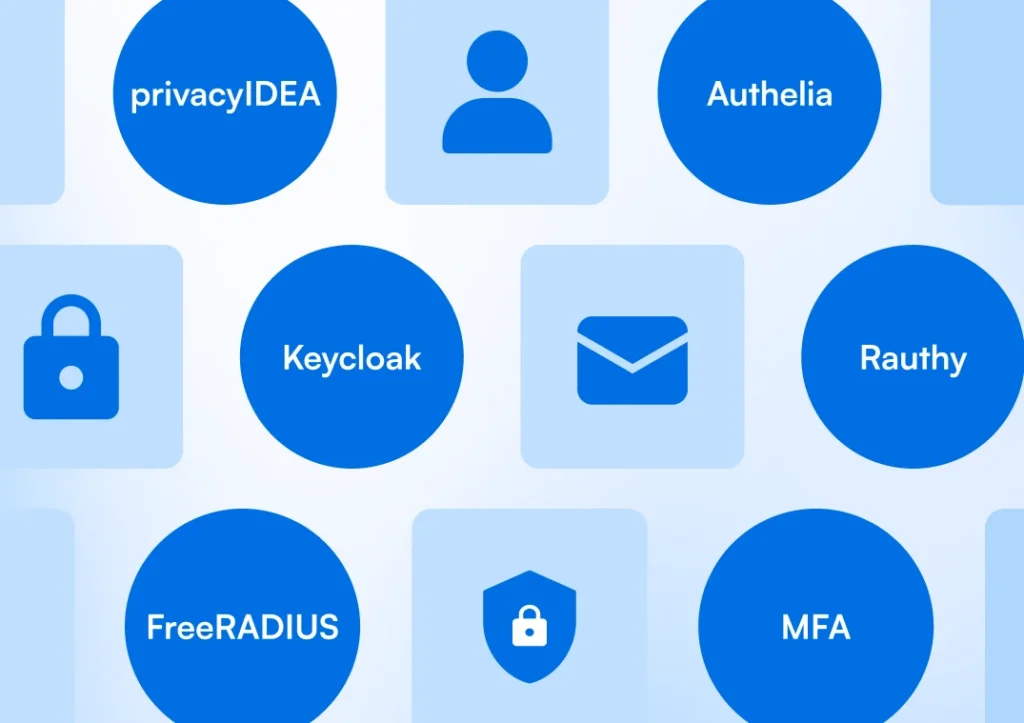
Top MFA Solutions: 5 Open-Source Options Compared
1. privacyIDEA
privacyIDEA is among the most feature-complete dedicated MFA platforms in the open-source space. It supports FIDO2/WebAuthn passkeys, hardware token management for devices like YubiKey, RADIUS integration for legacy apps, and LDAP/Active Directory connectivity for enterprise user management. Its policy engine is granular, letting you enforce different authentication methods by application, user group, or risk level. Deployment complexity is medium-high, your team needs Linux and Python familiarity, and production deployments benefit from a reverse proxy, TLS configuration, and a backend database.
For organizations facing cyber insurance PAM mandates, privacyIDEA integrates with CyberArk via a FreeRADIUS plugin. CyberArk forwards authentication requests to a RADIUS server running the privacyIDEA module, which validates the second factor and returns the result. It’s a documented integration path with a clear architecture, not a simple plug-and-play, but a repeatable one.
2. Keycloak
Keycloak is one of the most enterprise-complete open-source identity platforms available. It covers SSO, adaptive authentication policies, fine-grained admin controls, and broad SAML and OIDC protocol support. RADIUS integration is available via third-party adapters rather than natively out of the box. Red Hat’s community backing means active development and a mature upgrade path. If you need to broker identity between multiple upstream providers, enforce step-up authentication per application, or manage realm separation across business units, Keycloak handles all of it.
The tradeoff is configuration depth. Keycloak’s feature surface is substantial, and initial setup cycles are longer than lighter alternatives. Production deployments require a supported Java runtime or container platform, a production-grade database like PostgreSQL, TLS termination, and typically two or more nodes behind a load balancer for high availability. If your team doesn’t have dedicated platform engineering capacity, that overhead requires real planning.
3. Authelia
Authelia is the right fit when your primary requirement is lightweight, container-native two-factor authentication (2FA) enforcement at the application boundary. It runs cleanly on Docker Compose or Kubernetes, integrates as an OpenID Connect provider for downstream apps, and supports FIDO2/WebAuthn with a minimal operational footprint. For organizations that have already standardized on container infrastructure and need fast deployment, Authelia gets you there quickly.
The limitation worth noting: Authelia is designed as an identity provider for relying-party applications, not as an authentication broker layered in front of Okta or Microsoft Entra. If your goal is to federate upstream to an existing corporate IdP while adding a step-up policy layer, Keycloak is the better architectural fit. Authelia works best as the front door to specific applications, not as a policy orchestrator across the entire identity stack.
4. Rauthy
Rauthy is built specifically for organizations that want credential-phishing-proof, passwordless authentication from day one. According to the project’s official repository and documentation, its architecture is WebAuthn-first and designed around passkeys as the primary authentication mechanism rather than an add-on. It’s the strongest open-source option for greenfield deployments where you’re not carrying legacy OTP or RADIUS infrastructure into the environment.
The community is smaller and newer than privacyIDEA or Keycloak, reflected in lower GitHub contributor counts and less community-sourced troubleshooting documentation, which means fewer pre-built integrations. For teams comfortable on newer stacks and prioritizing insurer-preferred phishing-resistant methods, Rauthy delivers that posture without the complexity of a full IAM platform.
5. FreeRADIUS
FreeRADIUS isn’t a modern IAM platform and doesn’t try to be. It’s the specialist tool for environments with on-prem VPN concentrators, network access control systems, or applications that only speak RADIUS and can’t be updated. In hybrid infrastructure scenarios, FreeRADIUS is often irreplaceable. It’s frequently deployed alongside privacyIDEA, where FreeRADIUS handles the RADIUS protocol layer and privacyIDEA handles MFA token validation via its API.
If your environment is primarily cloud-native and modern, FreeRADIUS probably isn’t your primary solution. But if you have legacy infrastructure that can’t speak SAML or OIDC, it fills a gap that no other solution in this list addresses as effectively.
Integration compatibility: Okta, Microsoft Entra, and CyberArk
How open-source MFA layers into existing identity stacks
The most important architecture concept for mid-market teams evaluating top MFA solutions is that open-source tools don’t have to replace your existing identity provider. The proxy pattern is the standard approach: Keycloak sits in front of the application and enforces step-up authentication via OIDC brokering, while Okta or Microsoft Entra remains the corporate identity source for SSO. Keycloak federates upstream to Okta or Entra via OIDC, handles the step-up policy, and then issues tokens to the application. privacyIDEA, by contrast, typically integrates at the RADIUS or API layer rather than acting as an application-facing OIDC broker, a distinction worth clarifying during architecture planning.
This architecture eliminates the rip-and-replace risk that makes IT leaders hesitant to consider open-source alternatives. You’re adding an enforcement layer, not dismantling what works. For organizations already running Okta or Microsoft Entra, this means open-source MFA adds phishing-resistant authentication coverage and granular policies without disrupting existing application integrations.
Legacy app coverage without agent installation
The RADIUS-proxy and reverse-proxy patterns address the mid-market reality of mixed environments. privacyIDEA and FreeRADIUS together can protect on-prem applications that predate modern identity standards, with FreeRADIUS translating RADIUS requests into privacyIDEA API calls at the authentication layer. Reverse-proxy patterns place the authentication enforcement in front of the legacy app without touching its source code or installing agents on application servers, a practical approach for environments where code changes aren’t feasible.
Selecting the Best MFA Solution for CyberArk PAM Environments
For organizations facing cyber insurance PAM mandates, CyberArk integration is a common requirement. The most established integration path runs through RADIUS: CyberArk’s Password Vault or PVWA is configured to forward authentication to an external RADIUS server running the privacyIDEA plugin, which handles MFA validation and returns the result. CyberArk’s documentation outlines this PVWA-specific configuration flow. Custom configuration is required, but it follows a standard enterprise integration pattern rather than unsupported territory. A Keycloak-to-CyberArk integration path is less broadly documented; organizations pursuing that route should validate the specific architecture against CyberArk’s current integration guidance before committing.
Total cost of ownership: what open-source MFA actually costs
Licensing vs. implementation vs. ongoing support
Open-source MFA licensing is zero. Implementation is not. For a 500-seat mid-market enterprise, a realistic production rollout of privacyIDEA or Keycloak typically runs between 80 and 240 engineering hours, depending on stack complexity, directory integrations, RADIUS configuration, and enrollment workflow design. At market rates of $100 to $150 per hour, that’s $8,000 to $36,000 in implementation cost before ongoing maintenance begins. A heavily integrated rollout covering VPN, AD/LDAP, multiple app integrations, and policy tuning can push beyond 400 hours.
Ongoing support, patching, and high-availability maintenance don’t appear in any vendor comparison table, but they’re recurring line items. Major version upgrades in both Keycloak and privacyIDEA require migration planning, not just patch application, engineering time diverted from other security priorities every release cycle.
Hidden costs that erode the “free” advantage
The most common TCO surprise is incident response without a vendor SLA. When something breaks at 2 a.m. during a VPN outage, there’s no support desk to call. The remediation burden falls entirely on your team. Opportunity cost compounds this: senior engineers troubleshooting identity infrastructure aren’t working on other security priorities. Open-source MFA remains the right choice for many mid-market teams, but only when the operational budget reflects the real cost of running it reliably.
Cyber insurer requirements and accelerating compliant MFA deployment
What insurers actually audit in 2026
Underwriters in 2026 ask for specific evidence, not general attestation. They want identity-provider coverage reports showing MFA enrollment status for every account, and conditional access policy exports proving MFA is required for email, VPN, RDP, SSH, and cloud admin consoles. They also want sign-in logs demonstrating that privileged accounts actually passed through MFA during real login events. Beyond coverage, they want to see that legacy authentication protocols are disabled or restricted, and that exceptions for service accounts are documented with compensating controls like vaulting, IP allowlisting, or certificate-based authentication.
Hardware-backed authentication methods carry more weight than SMS OTP, especially for privileged and admin accounts. Per NIST SP 800-63B guidance and carrier audit conversations, FIDO2 hardware keys and passkeys satisfy the phishing-resistant standard that insurers increasingly require. SMS OTP is still accepted in many cases for standard user accounts, but it represents a weaker posture in an audit conversation.
Why deployment quality matters more than vendor choice
The gap between “MFA technically deployed” and “MFA that satisfies a cyber insurance audit” is an implementation gap, not a product gap. A fully configured privacyIDEA deployment with complete log coverage, FIDO2 enforcement on privileged accounts, and documented exception handling satisfies insurer requirements. A commercially licensed MFA platform with gaps in privileged account coverage does not. The vendor name on the invoice is not what underwriters are evaluating. They’re evaluating coverage completeness and evidence quality.
Where Sennovate fits in
Sennovate’s IAM practice is structured around integrations with Okta, Microsoft Entra, ForgeRock, and CyberArk, supporting both open-source and commercial MFA deployments in mid-market environments, including engagements tied to cyber insurance renewal timelines. The value isn’t replacing your existing stack. It’s deploying compliant MFA on top of what already works, with the audit documentation insurers need, on a timeline that fits your renewal window. That deployment scope, compliant configuration, audit documentation, renewal timeline, is the engagement model Sennovate’s IAM practice is structured around.
Choosing the right solution for your environment
The decision logic starts with your constraints, not a feature checklist. Keycloak is built for enterprise completeness, SSO federation, adaptive policy depth, and multi-realm administration. privacyIDEA is the stronger choice when flexible token management, RADIUS coverage, and CyberArk integration are the priority. For containerized environments where operational simplicity matters more than feature breadth, Authelia is purpose-fit. Rauthy is the right foundation for greenfield deployments that want phishing-resistant, passwordless authentication from the start rather than as a retrofit. FreeRADIUS remains the specialist for legacy infrastructure that simply can’t speak modern identity protocols.
The top MFA solutions for your organization aren’t ranked by features alone. The right fit among these MFA providers depends on your integration constraints, your team’s operational capacity, and the specific controls your insurer requires. Start by mapping your privileged account coverage gaps and your legacy app inventory, then match the solution to that reality. If you’re approaching a cyber insurance renewal and need compliant MFA deployed quickly, Sennovate’s IAM team can accelerate that timeline without disrupting the identity infrastructure you’ve already built.