How many AI agents are running in your environment? Who owns them? And what evidence exists if something goes wrong?
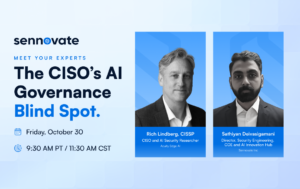
Those three questions framed The CISO’s AI Governance Blind Spot, our live session on October 30. Sathiyan Deivasigamani, Director of Security Engineering, COE and AI Innovation Hub at Sennovate, and Rich Lindberg, CISSP, a CISO and AI security researcher at Acuity Edge AI, spent 40 minutes on what AI governance for CISOs looks like once agents are already at work. Here are the key takeaways, two short clips, and the full recording.
Why access reviews miss AI agents
Access reviews were built for people: one person, one login, a stable role, reviewed once a quarter. AI agents break every one of those assumptions. They share logins or borrow an employee’s account, decide what to do on the fly based on what they read, and work around the clock.
Sathiyan shared three numbers from industry research that show the scale of the gap: 74% of AI agents get more access than their task needs, 68% of organizations can’t tell agent activity from human activity, and only 28% can link an agent’s actions to a responsible person.
That is why AI agents and other non human identities need their own governance, not a line item in the human access review.
Four questions to ask about every agent
Sathiyan’s starting point is four questions, asked of every agent in the environment:
- Who is it? Its own identity, not a shared login or a borrowed employee account.
- What can it touch? What it can actually reach, not what was approved on paper.
- What did it do? The actions it can take, and how far a single instruction can go.
- Can we prove it? One record that links the agent, its owner, the task and the outcome.
The question underneath all four: can you prove each agent stayed within its approved job?
Five rules for every AI agent
From there, the session set out five rules for agentic AI security:
- Its own identity. No shared logins, no borrowed employee accounts.
- A named owner. One accountable person, remapped whenever that person moves or leaves.
- Only the access it needs, for as long as it needs it. Least privilege at the task level, with permissions that expire.
- A human signs off on high impact actions. Payments, deletions and messages to the outside world need a clear approval step.
- An off switch that works. You can pause, disable or retire the agent when it’s no longer needed or something goes wrong.
Sathiyan’s challenge to the audience: pick your three busiest agents and check them against all five. Every “no” is a gap to close this quarter.
Watch for the dangerous combination
One idea drew particular attention. An agent with any one of these is manageable: access to private data, exposure to untrusted input such as email, web pages or files, and the ability to reach outside the organization. An agent with all three is a critical risk.
The example is simple. Someone sends an email telling the agent to ignore its previous instructions, collect private data and send it out. If the agent holds all three capabilities, nothing technical stands in the way. That’s where human approval and layered controls have to come in.
Don’t trust a control until you test it
Policies on paper don’t prove anything. The session closed its first half with four tests: compare an agent’s approved access with its real access; ask it to do something out of scope and confirm it’s blocked; trace one workflow end to end; and pull the plug on a misbehaving agent to confirm everything stops and the evidence is kept
Rich Lindberg: a CISO’s view
Rich has led security at 10 organizations, and his view is that AI agents are “really service accounts with some reasoning capability.” The controls aren’t new: separation of duties, just in time access, role based access and logging. What’s new is the velocity.
Two points stood out:
Start with detection and response. Most teams are joining a business that is already moving, not building greenfield. Treat AI like any insider threat, with managed detection and response as the safety net while the engineering catches up.
Attribution breaks when agents run under a user’s ID. Telling a person’s actions from an agent’s becomes a detection problem. Rich suggests a separate data lake of agent activity, so a compromised agent leaves a forensic trail.
Where should a CISO start?
Rich’s answer starts with people, not tools: partner with the business, gather the use cases, and run proofs of concept with real users, so teams don’t go off and buy shadow AI on their own. Sathiyan adds a discovery assessment, because agents are already running on laptops, servers, cloud and inside SaaS products.
What to do when you find agents nobody approved
For Rich, unapproved agents are the same conversation as shadow SaaS. Reach out, understand what the team is trying to do, and turn it into a sanctioned path others can use too. But AI raises the stakes, because it can move data out of the organization where no one can see it. He shared a breach at another company where his organization had to prove a leaked document didn’t come from them. Read more on shadow AI detection.
Three questions to take back to your team
How many AI agents are running today? If the answer takes more than a day, discovery is the gap.
Can every agent be traced back to an accountable person, with no shared logins or borrowed accounts?
Could we stop a misbehaving agent in minutes, and prove what it did before we stopped it?
What’s in the full recording
- 04:11 The numbers behind the blind spot
- 07:13 Four questions to ask about every agent
- 11:50 Five rules for every AI agent
- 14:02 The dangerous combination
- 17:20 Three questions to take back to your team
- 18:51 Rich Lindberg on agents, attribution and detection
- 31:02 Where a CISO should start
- 37:04 Agents nobody approved
Frequently asked questions
What is AI governance? AI governance is the set of policies, processes and controls an organization uses to adopt AI safely, responsibly and in line with regulations. It covers which AI tools are approved, how they use data, and how their access and actions are controlled and audited. See our AI governance glossary entry.
Why is AI governance an identity problem? Every AI agent acts through an identity, such as an API key, a service account or a delegated user token. Controlling what those identities can reach and do is identity security work, which is why AI governance and identity and access management teams need to work together.
Is the webinar recording free? Yes. The full session is available on demand at no cost.
Who should watch it? CISOs, security leaders, IAM teams, GRC and compliance teams, security architects and any enterprise rolling out AI agents.
Find out where you stand
Start with Sennovate’s free AI Risk Assessment: six questions, under three minutes. Or book a 20 minute discovery conversation with Sathiyan to map the agents already running in your environment, and explore our AI governance and security services.
Related Articles
The CISO’s AI Governance Blind Spot: Why AI Agents Need Identity Governance Now
Your newest privileged user doesn’t have a badge, a manager or a desk. It has...