Your newest privileged user doesn’t have a badge, a manager or a desk. It has an API key.
Across the enterprise, teams are already using AI: copilots in Microsoft 365, assistants built into every SaaS app, and agents connected directly to company data and systems. Each one acts through an identity. And most of those identities never go through the onboarding, access reviews or offboarding that every employee does.
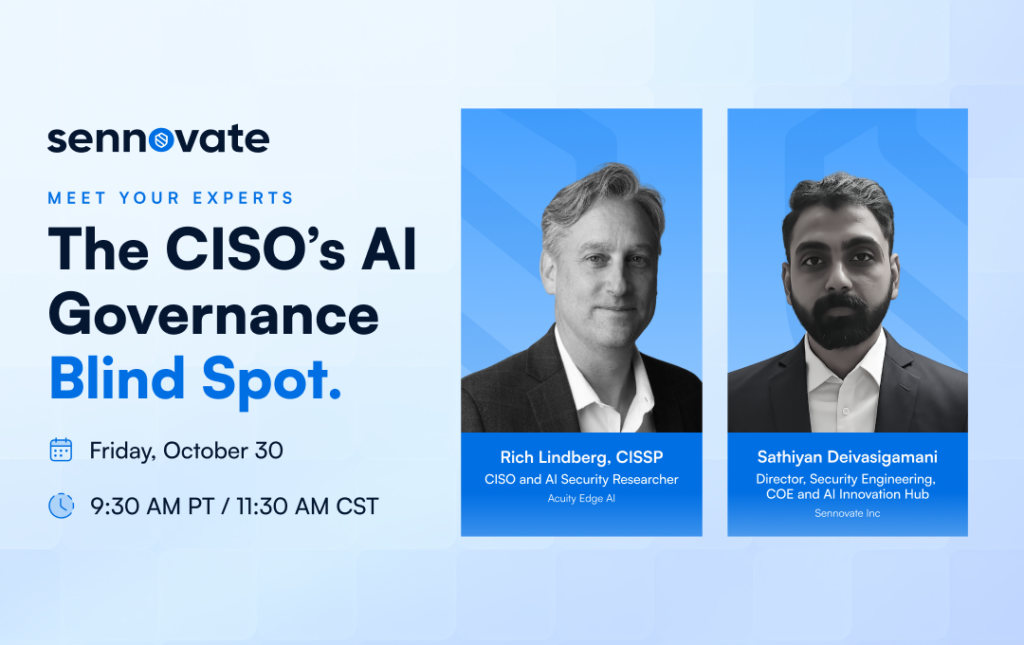
That is the CISO’s AI governance blind spot, and it is the focus of our live webinar on Friday, October 30, at 9:30 AM PT / 11:30 AM CST.
Why AI governance has a blind spot
Most organizations have started to govern AI. There are acceptable use policies, approved tool lists and review committees. That work matters, but it usually stops at the point of approval.
Once an AI tool or agent is running, the harder questions often go unanswered:
- Which credentials is it using: its own, a shared service account, or an employee’s personal token?
- What can it actually do inside each system it connects to?
- Who is accountable for it by name?
- How quickly could it be switched off, everywhere, if something went wrong?
These are identity questions. AI governance teams approve tools, and identity teams control access, but AI agents often fall between the two. Nobody owns the gap.
The numbers behind the problem
The scale of the issue is becoming clear in industry research:
- 97% of organizations that reported a breach of an AI model or application lacked proper AI access controls. (IBM, Cost of a Data Breach Report 2025)
- One in five organizations reported a breach due to shadow AI, and those with high levels of shadow AI paid an average of $670,000 more per breach. (IBM, Cost of a Data Breach Report 2025)
- Organizations now have 82 machine identities for every human, and 68% lack identity security controls for AI. (CyberArk, 2025 Identity Security Landscape)
AI adoption is moving faster than AI governance, and the gap is showing up in breach reports and audit findings.
What is shadow AI, and why does it matter?
Shadow AI is any AI tool, assistant or agent used inside an organization without the knowledge or approval of security and IT. A team connects an AI assistant to a shared drive. A developer gives a coding agent access to a repository with a personal token. A department signs up for an AI feature inside a SaaS app it already uses.
Each of these connections is a new access path. Without visibility, security leaders cannot assess the risk, apply controls or show auditors what is in place. You cannot govern what you cannot see. Read more in our guide to shadow AI detection.
Why AI agents are privileged identities
An AI agent with standing access to customer records, financial systems or production infrastructure is a privileged identity, whether or not anyone has labelled it that way.
The difference is that agents act at machine speed, often without a person in the loop, and frequently across several systems at once. If an agent is misconfigured or misused, its activity can look completely legitimate to the security team and approved to the identity team.
That is why AI agents and other nonhuman identities need the same discipline every privileged user already gets: discovery, a named owner, scoped access, continuous oversight and an audit trail that stands up to scrutiny.
What you’ll learn in the webinar
In this live session, an enterprise CISO and Sennovate’s Director of Security Engineering dig into the two gaps most AI governance programs miss: visibility into what’s already running, and accountability when agents act on their own.
The session covers six practical areas:
- See every AI tool and agent. How to build an inventory across sanctioned and shadow AI, including copilots, SaaS assistants and custom agents.
- Govern AI identities like users. How to give every agent a named owner, scoped access and a place in your access reviews.
- Close the shadow AI gap. How to find unmanaged AI connections and bring them under governance without starting a fight with the business.
- Guardrails without blocking innovation. Controls that keep pace with adoption, so teams can keep using AI safely.
- Audit ready evidence. What to capture so you can prove how AI access is approved, controlled and removed.
- Practical steps for this quarter. Where to start, and what good looks like in the first 90 days.
Meet the speakers
Rich Lindberg, CISSP
CISO and Principal AI Security Researcher, Acuity Edge AI
Rich brings the view of the security leader who has to answer for AI risk: how AI tools and agents are approved, secured and audited across the enterprise.
Sathiyan Deivasigamani
Director for Security Engineering, COE and AI Innovation Hub, Sennovate
Sathiyan leads the engineering side, building the controls that bring AI agents and nonhuman identities under the same governance as people.
Together, they bring both sides of the problem: the CISO who is accountable for AI risk, and the engineering leader who builds the controls that manage it.
Who should attend
This webinar is designed for leaders accountable for how AI is adopted, secured and audited across the enterprise:
- CISOs and security leaders
- IAM and identity teams
- GRC, risk and compliance teams
- Security architects and engineers
- Enterprises rolling out AI agents
If AI agents are already part of your environment, or will be soon, this is the conversation to have before your next audit asks the question for you.
Webinar details
- Title: The CISO’s AI Governance Blind Spot
- Date: Friday, October 30, 2026
- Time: 9:30 AM PT / 11:30 AM CST
- Format: Live on Zoom with Q&A
Frequently asked questions
What is AI governance? AI governance is the set of policies, processes and controls an organization uses to make sure AI is adopted safely, responsibly and in line with regulations. It covers which AI tools are approved, how they use data, and how their access and actions are controlled and audited. Learn more in our AI governance glossary entry.
Why is AI governance an identity problem? Every AI tool and agent acts through an identity, such as an API key, a service account or a delegated user token. Controlling what those identities can reach and do is identity security work, which is why AI governance and identity teams need to work together.
Who is this webinar for? CISOs, security leaders, IAM teams, GRC and compliance teams, security architects and any enterprise rolling out AI agents.
Can I send a question in advance? Yes. Register for the session and include your question, and the speakers will cover the most common ones during the live Q&A.
Get ahead of the AI governance blind spot
AI agents are already acting inside most enterprises. The organizations that bring them under identity governance now will scale AI with confidence. Those that wait will be rebuilding accountability later, under pressure from auditors, regulators or an incident.
Join us on Friday, October 30, to learn how to close the gap.
]
Want to see where you stand today? Start with Sennovate’s free AI Risk Assessment, or explore our AI governance and security services.
Related Articles
AI Agent Security: The Real Risks of Autonomous AI Agents
AI agents are moving beyond answering questions. They can search company data, call APIs, update...