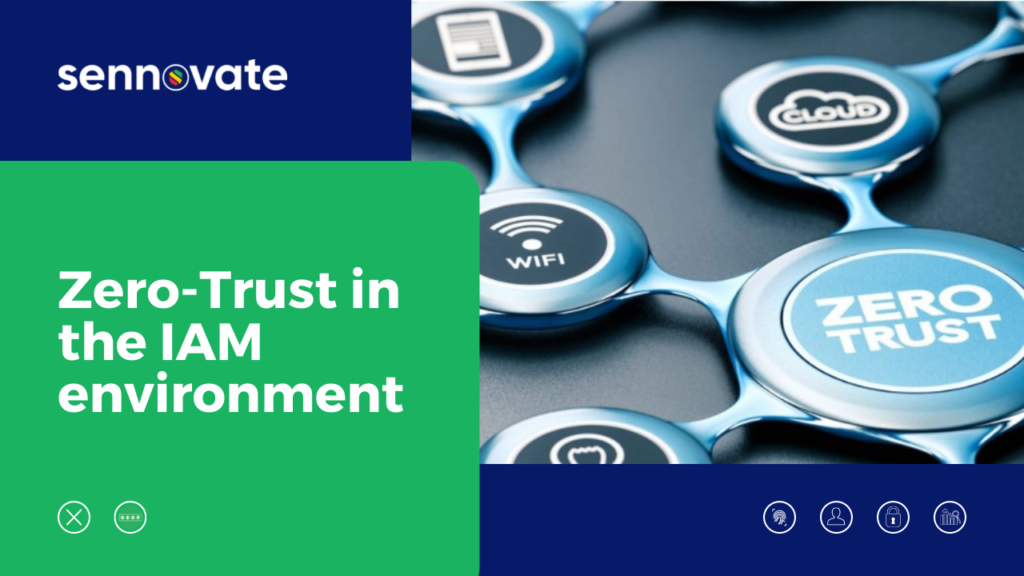
Identity access management has become a vitally important control of security in the light of growing threats. The perimeters used by organizations to defend themselves are swiftly fading. Two main factors that have increased the complexity of ensuring security to institutions are exposure to the cloud and remote work. Organizations now operate in what is called a zero-trust environment. In this situation, understanding and authenticating a person, verifying what this person or identity is allowed to do within the system, and services exposed to the identity no matter which device they are using become a core part of controlling the organization’s security.
The need for Zero Trust:
The Security Perimeter is no longer confined to the walls of an office building. Valuable business data flows relentlessly between Saas applications, IaaS applications, data centres, remote devices, IoT devices, and more. This inadvertently creates more entry points and wide attack vectors for malicious entities to infiltrate and remain hidden within the organization, collecting and causing damage to huge amounts of assets. The need for a new security paradigm was out of the question.What is Zero Trust?
Revolving around the principle of Never Trust, Always Verify, Zero Trust Network, or Zero Trust Architecture, was created in 2010 by John Kindervag, who at the time was a principal analyst at Forrester Research Inc. A zero-trust security state of mind is increasingly being adopted across the industry by security professionals. No device, user, workload, or system should be trusted by default irrespective of its location of operation, neither inside nor outside the security perimeter. According to a survey by Globenewswire, 72% of organizations plan to implement zero-trust capabilities in 2020. Zero-trust is a tangible security model with seven core security principles.Zero-trust networks:
When moving towards zero-trust security, it is crucial to divide and rule your network. Identifying your valuable assets and defining macro segments around them create multiple junctions and inspection points to block unauthorized lateral movement. In the event of a breach, a threat is easily contained and isolated.Zero-trust workloads:
It is essential for organizations to secure workloads, especially the ones that are running in the public cloud. The cloud assets (e.g. functions, containers, and VM’s) are vulnerable and highly susceptible to attacks from cybercriminals.Zero-trust data:
Zero-trust is implemented to protect the data while it is constantly moving between workstations, application servers, mobile devices, SaaS applications, databases, and across the corporate and public networks. This is ensured by- Encrypting your data, making it useless even if compromised.
- Tracking and controlling data movements across the network to ensure sensitive information does not leave the organization.
- Classifying and protecting business files and documents, inside and outside your organization.
Zero-trust people:
According to a report, 81% Of Company Data Breaches involving stolen credentials Due To Poor Passwords. Identities are easily compromised, so organizations should implement a combination of single-sign-on and multi-factor authentication to strengthen access control.Zero-trust devices:
Breaches increasingly involve compromised devices. Every device connected to your network should be treated as a threat factor be it a workstation, mobile or IoT device. This gives security teams to isolate, secure and control every device on the network at any given time.Visibility & Analytics:
If an organization cannot make sense of the huge amount of raw data that passes through their systems, it becomes difficult for them to protect themselves. A zero-trust security model gives emphasis on monitoring the data, logging the data, correlating, and analysing all activities over your network.Automation & Orchestration:
The Zero-trust model understands the importance and necessity of automating the infrastructure to enable speed and improved response, and to avoid having to leave tasks with people that have a high workload and increased scope for error. The complexity of securing an organization is increasing exponentially and adopting a security paradigm that can ensure maximum protection is vital. Exposure to the cloud and mobile work has inadvertently led to multiple vulnerabilities across the system leading to the need for a no-compromise security system like Zero-trust. With zero-trust implementations in identity access management, organizations have a way to secure their data and systems from different attacks occurring across the ecosystem. Zero-trust is a diverse security solution and has multiple layers, to learn more about zero-trust, listen in to our podcast featuring the creator himself, John Kindervag. CyberArk.Have questions about finding an Privileged Access Management consultant?
Call +1 (925) 918-6618 the consultation is free.
About Sennovate
Sennovate delivers custom identity and access management solutions to businesses around the world. With global partners and a library of 1000+ integrations, we implement world-class cybersecurity solutions that save your company time and money. We offer a seamless experience with integration across all cloud applications, and a single price for product, implementation, and support. Have questions? The consultation is always free. Email [email protected] or call us at: +1 (925) 918-6618Related Articles

Top 10 Vulnerability Management Tools for 2026: Prioritization, Remediation, and Cost
Discovered vulnerabilities have outpaced the ability of human security teams to remediate by 2026. The...