The Shifting Landscape of SOC Modernization in 2026
The enterprise security information and event management (SIEM) market is undergoing a major transition toward cloud-native delivery models. Legacy, on-premises SIEM architectures struggle with cost, performance, and operational efficiency when confronted with modern security telemetry. The contemporary threat surface spans multiple public clouds, thousands of Software-as-a-Service (SaaS) applications, distributed endpoints, artificial intelligence (AI)-powered workloads, and identity infrastructure generating data volumes that legacy systems cannot scale to ingest without significant performance compromise. This reality has forced a market consolidation. High-visibility transitions such as the end-of-sale phase for IBM QRadar SaaS, which redirects cloud-focused buyers toward Palo Alto Networks Cortex XSIAM, and the merger of Exabeam and LogRhythm into a consolidated cloud platform have fundamentally reshaped the buying landscape. Today, Splunk operates as a Cisco subsidiary, further aligning network visibility and real-time security analytics under a unified portfolio.
Faced with these shifts, security leaders are driving a movement toward SOC modernization. The primary goal is no longer simply storing expensive log files to satisfy compliance checkboxes; rather, modern security operations centers (SOCs) require platforms capable of proactive investigation, behavioral profiling, and autonomous containment. This trend is accelerated by macro-environmental pressures. Gartner observes that in 2026, security teams face geopolitical uncertainty, highly fragmented global regulatory frameworks, and the rapid proliferation of unmanaged AI agents that expand the corporate attack surface. Additionally, long-term risk planning requires organizations to inventory and transition their cryptographic implementations toward postquantum cryptography (PQC) standards to mitigate “harvest now, decrypt later” vulnerabilities before the 2030 threshold. Consequently, choosing the best SIEM platform is one of the most critical infrastructure decisions an enterprise security leader will make.
To manage these complex architectures without overstretching internal engineering staff, enterprises are increasingly adopting a managed SIEM model or integrating their core security analytics with an external MDR platform. This approach addresses the persistent capability gaps, constant alert fatigue, and operational underutilization that frequently render self-managed SIEM deployments ineffective.
Architectural Profiling of the Contenders
Evaluating the technical options in 2026 requires analysing three cloud-native and hybrid architectures: Google SecOps, Microsoft Sentinel, and Splunk Enterprise Security. While each platform claims to deliver end-to-end threat detection, investigation, and response (TDIR) capabilities, their underlying storage structures, data normalization schemas, and ingestion paths reflect completely different design principles.
Google SecOps
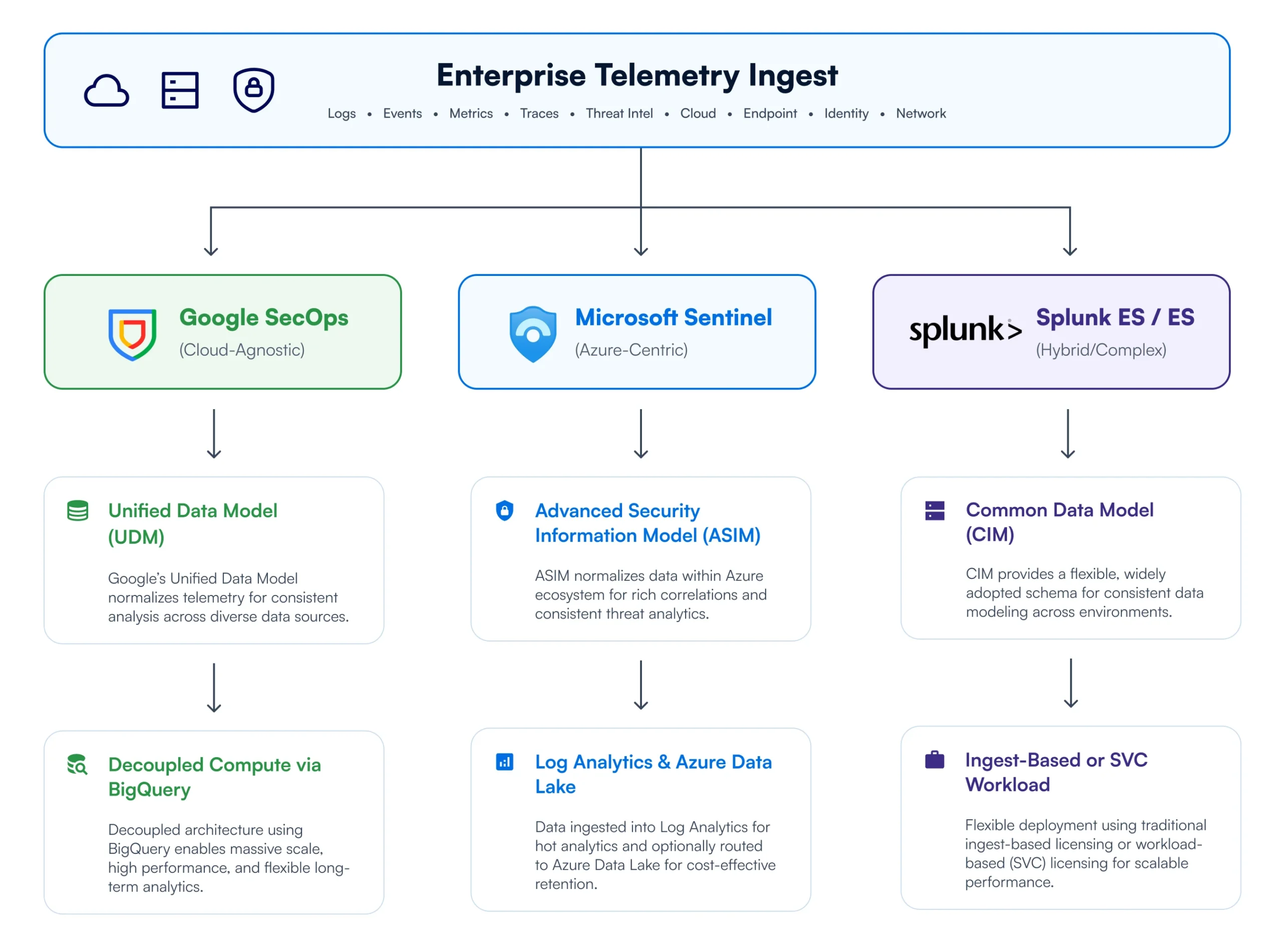
Google SecOps (formerly Chronicle) represents a cloud-agnostic, security-analytics approach built directly on Google’s global infrastructure. The platform utilizes a decoupled compute and storage architecture, relying on Google Kubernetes Engine (GKE) to scale search queries and load balance petabyte-scale ingestion in real time.
When telemetry is ingested, it is parsed and normalized into Google’s Unified Data Model (UDM). In 2026, Google has refined its UDM event mappings to improve data specificity and field-mapping context. For instance, Chrome DLP events have transitioned from generic classifications to targeted scan categories, while mobile device compromise alerts are mapped directly to host-level security scan classifications.
Furthermore, Google SecOps utilizes a five-day lookback window for entity-context data to seamlessly incorporate late-arriving logs into active investigations. Analysts can search raw, unparsed logs using regular expressions, while hot data can be exported to Google Big Query to support custom reporting and advanced security analytics.
Microsoft Sentinel
Microsoft Sentinel is a cloud-native platform tightly integrated with the Azure cloud and the broader Microsoft security portfolio. It processes logs within Azure Log Analytics workspaces, normalizing data through the Advanced Security Information Model (ASIM).
Sentinel operates on a two-tier data architecture. High-value, immediate alert sources (such as identity logs, endpoint alerts, and active threat intelligence) are processed in the Analytics Tier, driving real-time detection rules and incident creation. Conversely, high-volume telemetry (such as network firewalls, DNS lookups, and proxy logs) can be routed directly to the generally available Microsoft Sentinel Data Lake. This data lake tier separates compute and storage meters, allowing SOC teams to retain massive volumes of forensic data cost-effectively.
To streamline automated response, Microsoft Sentinel consistently maps user accounts to a standardized User Principal Name (UPN) prefix, preventing downstream playbook errors within Azure Logic Apps.
Splunk Enterprise Security
Splunk Enterprise Security (ES) remains the leading platform for hybrid and multi-cloud environments requiring extreme query flexibility. It supports self-managed on-premises installations, virtual cloud indexes (Splunk Cloud Platform), and hybrid architectures.
Splunk utilizes a schema-on-read approach, allowing security engineers to ingest unstructured logs and define fields dynamically during query execution using Splunk’s Search Processing Language (SPL). Normalization is achieved through Splunk’s Common Information Model (CIM).
Following its acquisition by Cisco, Splunk has deeply integrated with the Cisco Security Cloud ecosystem. This is demonstrated by the Cisco Security Cloud Application version 4.0.0, which introduces a syslog routing model for Firepower Threat Defense (FTD) devices. This application separates syslog feeds into highly targeted event families rather than routing them under a generic syslog category, improving field extraction accuracy, Cim data model mapping, and query performance.
| Architectural Vector | Google SecOps | Microsoft Sentinel | Splunk Enterprise Security |
| Primary Cloud Infrastructure | Google Cloud Platform (GCP) | Microsoft Azure | On-Premises, Splunk Cloud, or Hybrid |
| Normalisation Standard | Unified Data Model (UDM) | Advanced Security Information Model (ASIM) | Common Information Model (CIM) |
| Primary Query Engine | YARA-L, Gemini Natural Language | Kusto Query Language (KQL) | Search Processing Language (SPL) |
| Storage Separation | Managed BigQuery Advanced Export | Log Analytics Workspace & Azure Data Lake | Indexer Storage Blocks & Cold S3 Archives |
| Federation Capabilities | BigQuery Advanced Export | Cross-workspace data federation | Federated Search & Federated Analytics |
Comprehensive SIEM Comparison: Detailed Features and Capabilities
An objective SIEM comparison in 2026 must evaluate three core capabilities: threat detection engines, integrated threat intelligence, and the deployment of generative, agentic AI.
Threat Detection Engineering and Analytics
Threat detection mechanisms represent a key point of divergence among the platforms. Google SecOps utilizes a rule-authoring engine based on the YARA-L language, which is purpose-built for expressing multi-event correlations over time. A major advantage of Google’s detection engine is Retrohunt, which enables security analysts to instantly run newly written YARA-L rules against up to 12 months of hot historical data to uncover past compromises.
Microsoft Sentinel uses KQL analytics rule templates, backed by its specialized Fusion correlation engine. Fusion leverages machine learning models to analyze low-fidelity signals across endpoints, identities, and cloud platforms, automatically aggregating related events into unified, high-confidence security incidents.
Splunk Enterprise Security relies on Risk-Based Alerting (RBA) to map security events to a centralized risk index. RBA groups risk events by user or system entity and triggers a high-fidelity alert only when cumulative risk thresholds are breached, reducing traditional SIEM alert volume by up to 90%. Splunk ES 8.x further introduces time-skew detection capabilities, allowing administrators to offset scheduled query runtimes and balance indexing loads.
Integrated Threat Intelligence
Threat intelligence feeds must be natively incorporated into the analyst workflow to minimize investigation timelines:
- Google SecOps natively integrates threat intelligence through Google Threat Intelligence (GTI) Enterprise. This subscription combines global telemetry from VirusTotal with the frontline incident response insights of Mandiant. This integration powers breach analytics, matching telemetry against newly discovered threat indicators in near real-time.
- Microsoft Sentinel utilizes Microsoft Defender Threat Intelligence (MDTI) and global security signals. Security teams can import external threat indicators via STIX format connectors and cross-reference them with active workspace logs using built-in query tables.
- Splunk Enterprise Security integrates real-time intelligence from Cisco Talos at no additional cost. The Talos network provides extensive threat research and curated indicators of compromise (IOCs) directly to the TDIR workflow, helping analyst teams triage alerts and speed up incident containment.
Generative AI and Autonomous Agent Architectures
The integration of agentic AI is a defining trend in 2026, shifting security tools from conversational help assistants to autonomous threat analysts:
- Gemini in Google SecOps is built directly into the platform license. Gemini translates natural language prompts into working YARA-L rules, summarizes complex security cases, and drafts incident response plans. By utilizing the Model Context Protocol (MCP), Gemini can also connect to remote servers to fetch context across external application pipelines.
- Microsoft Security Copilot serves as an AI-powered assistant across the Microsoft Defender and Sentinel platforms. Copilot simplifies triage by summarizing alerts, identifying script evasion patterns, and providing step-by-step containment instructions. However, Copilot is billed separately based on Security Compute Units (SCUs), which can add variable costs to the security budget.
- Splunk ES Premier introduces task-specific AI agents, including the Triage Agent (which automates alert assessment based on historical context), the Malware Reversal Agent (which extracts IOCs and explains malicious scripts), and the Detection Builder Agent. Analysts can also use natural language to draft verified SOAR playbooks directly inside the Splunk Visual Playbook Editor.
Decision Framework: Selecting the Best SIEM Platform
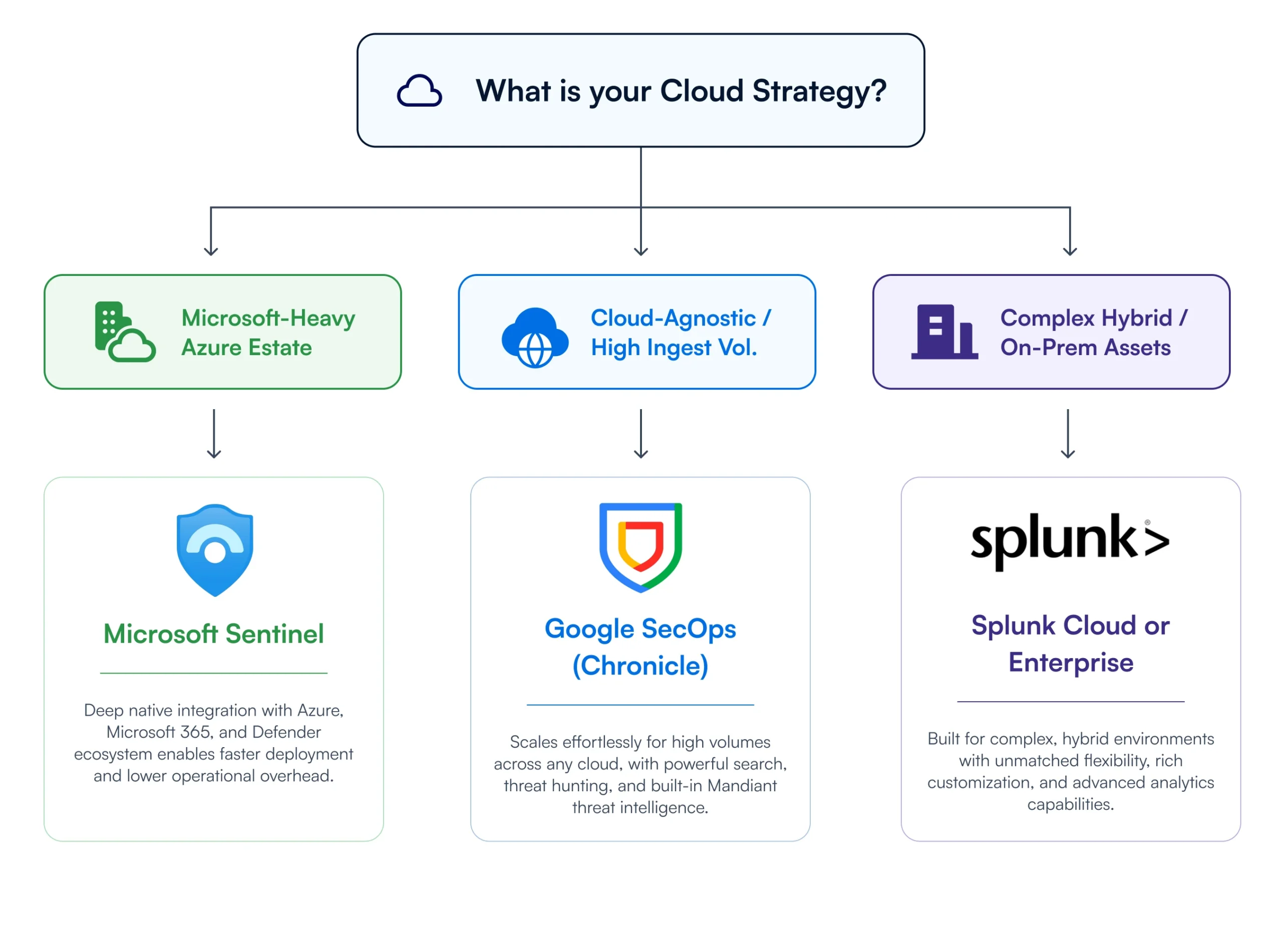
Choosing the right SIEM platform in 2026 is an ecosystem and operational decision rather than a feature comparison. Security leaders must evaluate each platform against their existing cloud commitment, log volume, and internal engineering resources.
Scenario 1: The Microsoft-Heavy Estate
For organizations with infrastructure heavily centered on Microsoft Azure, Microsoft 365, and Defender XDR, Microsoft Sentinel is the optimal choice.
- Strategic Rationale: Sentinel provides seamless integration with Microsoft security logs, enabling rapid time-to-value without complex deployment overhead. The automatic 5 MB per user per day ingestion credit for M365 E5 customers significantly offsets the licensing cost of identity and activity logs.
- Operational Requirements: SOC teams can easily build detection rules using KQL and automate standard responses with Azure Logic Apps.
- Implementation Focus: Teams must actively govern third-party data ingestion (such as multi-cloud trails or legacy network syslog feeds) to avoid cost overruns at scale.
Scenario 2: High Ingestion Multi-Cloud and Platform Consolidation
For multi-cloud or cloud-agnostic organizations handling massive, diverse telemetry volumes, Google SecOps is the premier choice.
- Strategic Rationale: Google’s headcount-based licensing eliminates the cost penalties associated with traditional ingestion metrics, allowing security teams to focus on collecting necessary telemetry rather than managing data caps.
- Operational Requirements: The default inclusion of 12 months of hot storage enables sub-second retroactive threat hunting across historical datasets. Integrated Gemini AI and Mandiant Threat Intelligence help scale operations and accelerate triage workflows.
- Implementation Focus: SOC teams must adapt to the YARA-L rule-authoring language, which may require dedicated training or co-managed MDR engineering support.
Scenario 3: Large-Scale, Complex Hybrid Environments
For mature, engineering-heavy enterprises managing complex hybrid infrastructures, on-premises datacenters, and diverse third-party applications, Splunk Enterprise Security remains the standard.
- Strategic Rationale: Splunk’s SPL query flexibility and schema-on-read capabilities can parse and correlate virtually any unstructured logging format. Integrations with the Cisco Security Cloud provide advanced network flow analysis and embedded Cisco Talos threat intelligence natively within the TDIR lifecycle.
- Operational Requirements: Dedicated Splunk administrators can implement highly customized Risk-Based Alerting (RBA) to map security events to a centralized risk index. Splunk ES Premier also democratizes SOAR by removing per-seat licensing limits.
- Implementation Focus: Organizations must plan for substantial operational administration and infrastructure overhead, actively managing workloads via Splunk Virtual Compute (SVC) allocations to prevent performance bottlenecks.
Related Articles
Zero Trust Network Access Won’t Save You If Standing Privileges Are Still Open
Most zero trust rollouts start in the same place: network segmentation, device posture checks, a...