When enterprises operate across multiple cloud environments, what they cannot see becomes their biggest vulnerability.
The Threat You Never Noticed
Here’s a scenario that plays out more often than most security teams would like to admit.
Alerts are firing. Dashboards are green. The SOC is staffed. And somewhere in the background, an attacker has been quietly moving through your cloud environment for the past three weeks — not because your tools missed it, but because no tool was ever watching that corner of your infrastructure to begin with.
That’s what multi-cloud visibility gaps actually look like in the real world. Not dramatic. Not loud. Just a slow, silent exposure that grows every time a new cloud service gets spun up, a new team deploys a workload without telling security, or a forgotten API endpoint keeps quietly sending data somewhere it shouldn’t.
The hard truth about cloud security risks in 2026 is that most breaches don’t happen because attackers are impossibly sophisticated. They happen because organizations can’t see their whole environment — and they’re defending the parts they can see while ignoring the rest. You can’t protect what you don’t know exists. That’s always been true, but in a multi-cloud world, it’s become a serious enterprise problem.
What Are Multi-Cloud Visibility Gaps?
A visibility gap is exactly what it sounds like, a part of your environment where your security tools have no line of sight. No logs. No alerts. No monitoring. Just a blind spot sitting there, waiting.
In a single data center, these gaps are annoying but manageable. In a multi-cloud enterprise running workloads across AWS, Azure, Google Cloud, and on-premises infrastructure simultaneously, they’re everywhere. They show up when teams deploy cloud services without looping in security. They show up in encrypted traffic that passes through your network uninspected. They show up in containerized microservices talking to each other with no one watching. They show up in legacy assets that got connected to your cloud network and never properly inventoried.
Each one of those scenarios is a security blind spot — a place where a threat can persist, spread, and cause real damage long before anyone on your team notices it.
Why Multi-Cloud Amplifies the Risk
Running one cloud environment is hard enough. Running three or four is a completely different problem.
Every cloud provider has its own native security and monitoring tools, built to work well within their own ecosystem. The problem is that your attackers don’t stay in one ecosystem. A breach that starts in one environment can move to another before any single provider’s tool has flagged a thing. Meanwhile, your security team is trying to correlate alerts from four different platforms, in four different formats, with no unified view of what’s actually happening across the whole estate.
The result is what you’d expect: fragmented cloud monitoring, gaps between platforms, and a security posture that’s only as strong as its weakest unmonitored segment.
And the downstream effects aren’t subtle. Threat detection slows way down when signals are scattered across tools — by the time an incident gets pieced together from multiple sources, hours or days have already passed. Alert fatigue sets in when volume goes up and context goes down, and analysts start missing the real warnings buried in the noise. Compliance gets painful too — regulations like PCI DSS v4.0, GDPR, and HIPAA don’t accept “we couldn’t see that part of our environment” as an answer, and the fines for proving it are getting bigger every year.
And then there are cloud misconfigurations — publicly exposed storage buckets, open API endpoints, over-permissioned service accounts — sitting untouched because no one’s tool was watching that cloud account. Not because anyone made a careless decision, just because hybrid cloud risks scale faster than visibility does.
The Five Most Dangerous Enterprise Cloud Blind Spots
1. Traffic That Moves Sideways
Most security tools are built to watch what comes in and goes out of a network. But in multi-cloud environments, a huge chunk of the real risk is in east-west traffic services talking to other services inside the environment. Once an attacker gets a foothold, they move laterally. And if there’s nothing watching those internal flows, they can move freely between workloads and databases without ever triggering an alert.
2. APIs Nobody Remembers
APIs run almost everything in a modern cloud architecture, and the vast majority of enterprise API estates have shadow APIs undocumented, forgotten, or unmanaged endpoints that are still out there transmitting sensitive data. Security teams that don’t have full API discovery in place are operating with one of the most significant cloud blind spots an organization can have. Attackers know this. They specifically look for these.
3. Misconfigurations That Just Sit There
An S3 bucket left public. A database with no encryption. An IAM role with permissions nobody audited in two years. Cloud misconfigurations aren’t exotic attack vectors they’re everyday mistakes that become major security events when they’re not caught. In a multi-cloud environment with no single control plane watching all resources, these things can sit exposed for months. They usually get found by someone the question is whether it’s your team or someone else’s.
4. Identities Nobody’s Watching
Enterprises accumulate identities fast service accounts, machine tokens, API keys, orphaned credentials from employees who left six months ago. Most of them never get reviewed. Many of them have more permissions than they should. All of them are potential entry points. Identity is the new perimeter in cloud security, and if you don’t have visibility into what all those identities are doing, you’ve got a serious gap in your security posture.
5. Threats Hiding in Encrypted Traffic
Here’s one that surprises people: encrypted traffic isn’t automatically safe traffic. Encryption protects legitimate data in transit, yes — but it also hides malicious payloads from detection tools that can’t see inside it. Threat actors increasingly use encrypted channels precisely because they know most organizations aren’t inspecting them. If you’re not doing any encrypted traffic inspection, you’ve got a blind spot that attackers are actively exploiting.
Detection Is Not Enough: The Prevention Gap
Here’s where a lot of security programs hit a wall. The investment has gone into cloud threat detection monitoring platforms, SIEM dashboards, cloud-native security tools. Alerts are firing. Visibility is improving. And breaches are still happening.
The issue isn’t that detection doesn’t work. It does. The issue is that detection and prevention are two different things, and the gap between them is where the damage happens.
When an alert fires, it kicks off a chain of events: the SOC validates the alert, escalates it, gets the cloud operations team on the phone, reviews the blast radius, waits for leadership sign-off, and finally finally begins enforcement. That process, even in a well-run organization, can take 30 to 60 minutes. For ransomware, that’s more than enough time to encrypt your critical systems. For data exfiltration, it’s way more than enough to empty a database.
Detection tells you something happened. It doesn’t stop happening. That’s why cloud visibility tools need to be paired with automated, inline enforcement controls that respond in near-real time, not after a coordination meeting. The architecture question in 2026 isn’t just “can we see the threat?” It’s “can we stop it before it matters?”
How to Close Visibility Gaps in 2026
There’s no single tool that solves this. The organizations handling multi-cloud security well are the ones building layered capabilities that work together each one covering what the others miss.
Cloud Security Posture Management (CSPM) gives you continuous visibility into the configuration state of every cloud resource, across every provider. Misconfigurations get flagged in real time instead of surfacing in a quarterly audit six months too late. The best CSPM platforms in 2026 are also moving into runtime threat detection and identity risk not just “is this configured correctly?” but “is something actively wrong right now?”
Micro segmentation tackles the east-west traffic problem by breaking the network into small, monitored zones with explicit policies between them. It sounds technical, but the practical outcome is straightforward: you can see what’s talking to what, spot anything that shouldn’t be communicating, and contain a threat before it spreads. It also gives you the audit trails that compliance teams actually want to see.
API discovery and protection means doing a real inventory of every API in your environment managed or not, current or forgotten assessing what data it handles and who can access it. If you don’t know your full API estate, you can’t protect it, and you almost certainly can’t prove compliance with frameworks that require you to demonstrate it.
Network traffic analysis with encrypted traffic inspection closes the blind spot most organizations don’t even know they have. Behavioral analytics layered on top of NTA can catch threats that signature-based tools miss entirely anomalies in traffic patterns that don’t match any known signature but definitely don’t look right.
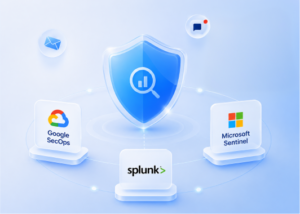
SIEM and SOAR integration turns all of that visibility into action. Data from every cloud environment, every tool, every log source correlated in one place, with automated playbooks that compress the response window from 45 minutes to something much closer to real time.
And underneath all of it: continuous asset inventory. Not a quarterly audit. Real-time scanning, because cloud environments change every day and your visibility needs to keep up with them.
Not Just a Tools Problem
Here’s the uncomfortable part: you can have all the right cloud visibility tools and still have massive blind spots because the problem isn’t only technical; it’s organizational.
The enterprises that genuinely stay on top of enterprise cloud security have built visibility into how they work, not just what they buy. New cloud resources get automatically enrolled in monitoring at provisioning time. Logging is mandatory across every environment, not just the ones someone decided were high-risk. Security, cloud ops, and development teams share ownership of blind spots instead of pointing at each other. And red team exercises are specifically designed to find the gaps that the monitoring stack missed.
In 2026, the organizations most exposed to cloud security risks aren’t the ones that haven’t bought the right tools. They’re the ones that haven’t applied them everywhere they need to be.
What You Don’t See Will Hurt You — But Sennovate Can Help
Multi-cloud environments have changed everything about how enterprises operate. The flexibility, the scalability, the speed — it’s genuinely transformative. But that same sprawl creates an attack surface that’s really hard to watch all at once, and the places you’re not watching are exactly where serious threats take hold.
Visibility gaps in cloud environments aren’t hypothetical risks. They’re the conditions under which real data gets stolen, real operations get disrupted, and real compliance failures happen. The organizations that close those gaps and pair visibility with the ability to actually act on it are the ones that catch things before they become headlines.
That’s where Sennovate comes in.
Sennovate is a managed security services provider that works with enterprises in exactly these environments complex, multi-cloud, fast-moving and helps them build the visibility and enforcement capability to stay ahead of threats instead of reacting to them.
On the network security side, Sennovate designs and deploys VPC architectures, security groups, and east-west traffic controls across AWS, Azure, and Google Cloud, so security teams finally have a clear picture of what’s communicating with what across their entire cloud estate. CASB and Secure Web Gateway integrations extend that visibility into how cloud applications are being used and whether policies are actually being followed.
For perimeter security, Sennovate deploys intelligent firewalls with TLS/SSL inspection specifically addressing the encrypted traffic blind spot alongside Zero Trust Architecture and SASE frameworks that make sure every access point, whether it’s on-premises or sitting in a cloud environment, falls inside the monitored perimeter.
Sennovate’s security operations practice ties it all together. Firewalls, EDR, IAM, SIEM, and cloud tools all integrated into a single visibility and response layer, backed by a 24/7 SOC, AI-powered behavioral analytics, and threat hunting mapped to the MITRE ATT&CK framework. That’s the part that closes the gap between “we detected it” and “we stopped it” before the 45-minute window runs out.
And on the data security side, Sennovate automatically discovers, classifies, and governs sensitive data across on-premises, cloud, and SaaS environments, so you always know where your most critical assets live, who’s accessing them, and whether that access looks legitimate.
Closing visibility gaps isn’t a one-time project. It’s ongoing work, and it’s the kind of work that’s hard to do well without the right partner. Sennovate brings the expertise, the integrations, and the 24/7 operational support to make comprehensive cloud visibility something your team can actually sustain.
Related Articles

Top 10 Vulnerability Management Tools for 2026: Prioritization, Remediation, and Cost
Discovered vulnerabilities have outpaced the ability of human security teams to remediate by 2026. The...